Services Overview
Therapy is designed to create meaningful progress — not to continue indefinitely.
Clear goals and an approach that evolves as your child grows.
Pediatric Speech and Language Evaluations
Speech with Layla provides comprehensive pediatric speech and language evaluations in Edina and the greater Twin Cities. Evaluations are individualized to understand your child’s communication strengths, identify areas that may need support, and provide clear recommendations for treatment and next steps.
-
If your child is difficult to understand, says certain sounds incorrectly, or seems to be making more speech errors than other children their age, a comprehensive speech sound evaluation can help determine why.
During the evaluation, I look beyond whether your child can say individual sounds correctly. I assess how they produce sounds in both words and connected speech, overall speech intelligibility (how easily others can understand them), and whether their errors follow predictable patterns. I also look at stimulability—how your child responds to cues for sounds they are not yet producing—and examine the structures and movements used for speech. When appropriate, standardized testing is combined with conversation, play, and other clinical measures to provide a more complete picture of your child’s speech.
The goal is to understand whether your child is experiencing an articulation disorder, phonological disorder, or another type of speech sound difficulty and, most importantly, what will help.
Following the evaluation, you’ll receive clear results and practical recommendations. If speech therapy is recommended, we’ll identify meaningful treatment targets and develop an individualized plan focused on improving your child’s speech clarity and confidence.
-
If your child is very difficult to understand, has inconsistent speech errors, struggles to imitate words, or has made limited progress in traditional speech therapy, a comprehensive motor speech evaluation can help determine what may be contributing to their speech difficulties.
During the evaluation, I look closely at how your child plans and coordinates the movements needed for speech. I assess consonants and vowels, syllable and word shapes, consistency of productions, transitions between sounds and syllables, speech rhythm and stress (prosody), and overall speech intelligibility. I also use dynamic assessment to see how your child’s speech changes with different types of cues and support. These observations are important because childhood apraxia of speech (CAS) cannot be diagnosed from one symptom or a single standardized test.
The goal is to determine whether your child’s speech characteristics are consistent with childhood apraxia of speech, another motor speech disorder, a phonological disorder, or a different type of speech sound difficulty. Accurate differential diagnosis matters because these disorders may require different approaches to treatment.
Following the evaluation, you’ll receive clear results, recommendations, and an individualized treatment plan when therapy is recommended. The goal is not simply to name a diagnosis, but to understand how your child learns speech best and identify the approach most likely to support meaningful progress.
-
If your child is not yet using words, has a limited vocabulary, is not combining words as expected, or seems to have difficulty understanding language, an early language evaluation can help you better understand their communication development and whether additional support may be helpful.
For children from birth to age three, evaluations are play-based and designed to feel natural and comfortable. I look at both receptive language—what your child understands—and expressive language—how they communicate their wants, needs, ideas, and interests. I also assess important early communication skills such as gestures, imitation, play, social interaction, joint attention, and the different ways your child communicates with the people around them. Parent input is an essential part of the evaluation because you know your child best and see their communication across everyday routines and environments.
The goal is to understand your child’s unique communication strengths, identify areas where development may need additional support, and determine whether speech and language therapy is recommended.
Following the evaluation, you’ll receive clear results and practical recommendations tailored to your child and family. When therapy is recommended, we’ll develop meaningful goals and identify strategies you can naturally incorporate into everyday routines to support your child’s communication and language development.
-
If your child has difficulty understanding directions, expressing their thoughts clearly, answering questions, telling stories, learning new vocabulary, or keeping up with the language demands of school and everyday conversations, a comprehensive language evaluation can help identify their strengths and areas where additional support may be helpful.
During the evaluation, I assess both receptive language—how your child understands spoken language—and expressive language—how they use words and sentences to communicate. Depending on your child’s age and individual needs, I may also evaluate vocabulary, grammar, sentence structure, following directions, understanding questions and concepts, storytelling and narrative skills, and social communication. Standardized testing is combined with conversation, observation, parent input, and other clinical measures to provide a more complete picture of how your child communicates in everyday life.
The goal is to determine whether your child’s language skills are developing as expected, understand the nature of any language difficulties, and identify the areas that would be most meaningful to address.
Following the evaluation, you’ll receive clear results and practical recommendations. If speech and language therapy is recommended, we’ll develop individualized goals designed to strengthen your child’s communication skills and support meaningful progress at home, at school, and in everyday interactions.
-
If your child repeats sounds, syllables, or words, stretches out sounds, experiences blocks where words feel stuck, or shows tension or frustration when speaking, a comprehensive stuttering evaluation can help you better understand their communication and determine whether support may be helpful.
During the evaluation, I look at much more than how often your child stutters. I assess the types and patterns of stuttering, how stuttering varies across speaking situations, and whether your child experiences physical tension or secondary behaviors. Just as importantly, I consider how your child feels about speaking, whether stuttering affects their confidence or participation, and how they communicate at home, at school, and with peers. Parent and child perspectives are an important part of understanding the full impact of stuttering.
The goal is to develop a complete picture of your child’s communication—not simply to count moments of stuttering. For younger children, the evaluation also considers factors that can help guide decisions about whether therapy, monitoring, or parent support is appropriate.
Following the evaluation, you’ll receive clear results and individualized recommendations. If stuttering therapy is recommended, treatment is designed to support confident, effective communication while respecting your child’s individual experience of stuttering.
-
If your child communicates differently, has difficulty expressing their wants, needs, or ideas, struggles to understand language, or needs additional support navigating social communication, a comprehensive evaluation can help identify their communication strengths and determine what support may be meaningful.
During the evaluation, I take a strengths-based, neurodiversity-affirming approach to understanding how your child communicates. Depending on your child’s individual needs, I may assess receptive and expressive language, social communication, play, gestures, self-advocacy, conversational skills, and how your child communicates across different people and environments. I also consider all forms of communication, including spoken language, gestures, signs, and augmentative and alternative communication (AAC), when appropriate. Parent and caregiver perspectives are an important part of developing a complete picture of your child’s communication.
The goal is not to teach your child to appear less autistic or to eliminate communication differences that are simply part of who they are. Instead, the evaluation helps identify barriers to effective communication and areas where support could increase your child’s autonomy, participation, connection, and ability to communicate their needs and ideas.
Following the evaluation, you’ll receive clear results and individualized recommendations. If speech and language therapy is recommended, goals are developed collaboratively and focus on meaningful communication skills that support your child in everyday life.
-
If you already have an evaluation, diagnosis, or speech therapy plan but still have questions, a second opinion or treatment planning consultation can provide additional clarity and help you determine the best next steps for your child.
During the consultation, I review your child’s history, previous evaluations, therapy goals, progress, and any relevant reports or recommendations. Depending on your concerns, we may discuss whether the current diagnosis and treatment approach fit your child’s communication profile, whether therapy goals are targeting the most meaningful skills, and whether the frequency or type of treatment is appropriate. For children who have made limited progress in speech therapy, we can also explore possible reasons why and consider whether a different approach may be beneficial.
Second opinions can be especially helpful for families navigating childhood apraxia of speech (CAS), complex or persistent speech sound disorders, language difficulties, stuttering, or neurodivergent communication needs.
The goal is to give you a clearer understanding of your child’s communication needs and help you feel confident about the path forward. Following the consultation, you’ll receive practical recommendations for next steps, which may include changes to treatment goals or approach, additional assessment, home strategies, or guidance for collaborating with your child’s current speech-language pathologist or care team.
Pediatric Speech and Language Therapy
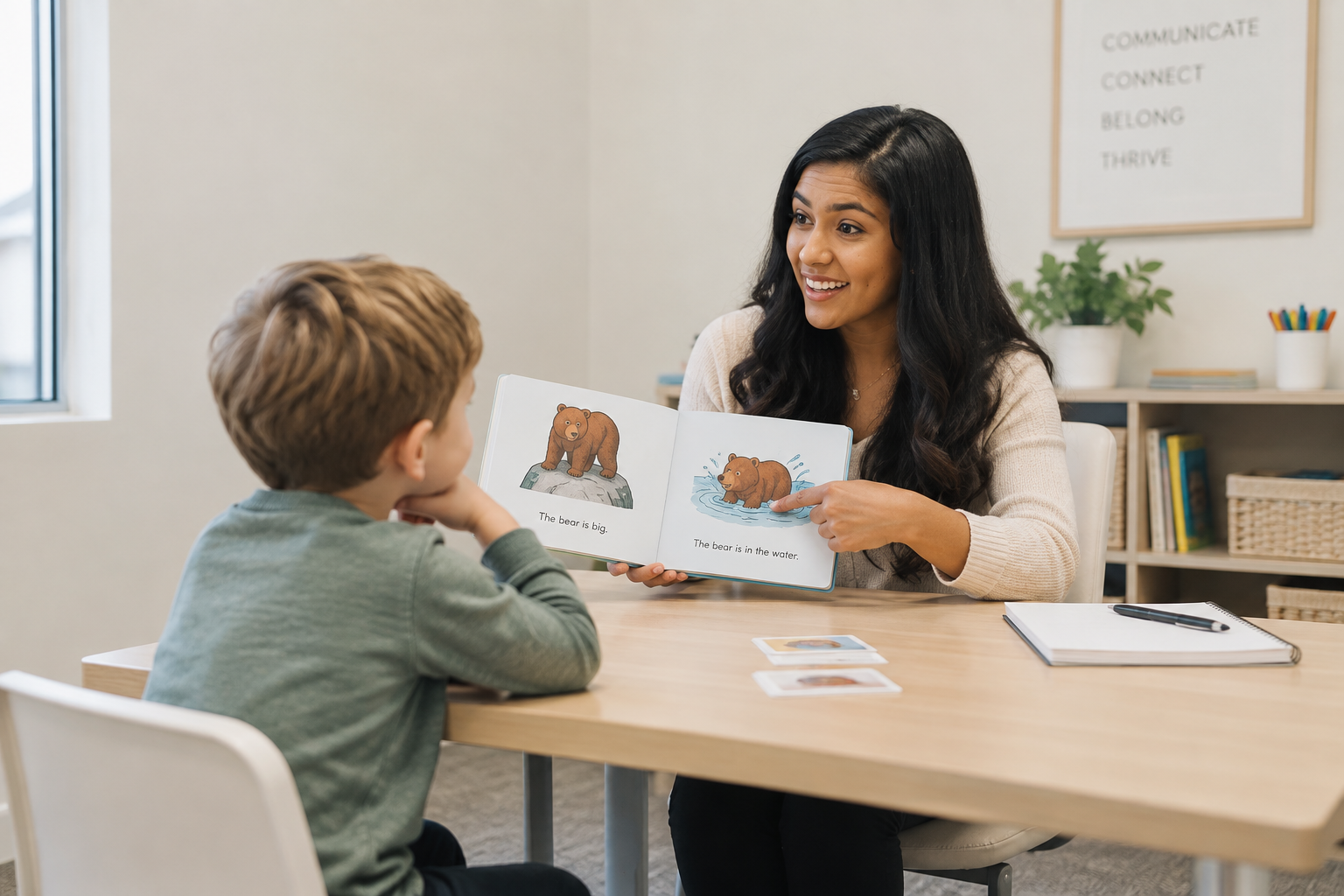
Speech and language therapy is individualized to your child’s communication needs, strengths, and goals. I provide evidence-based therapy for speech sound disorders, childhood apraxia of speech (CAS), language development, stuttering, and autistic and neurodivergent communication. Every session is designed with meaningful progress in mind—we’ll track your child’s progress, adjust the treatment approach when needed, and help skills carry over beyond the therapy room. The goal isn’t to keep your child in therapy indefinitely, but to provide effective support, build meaningful communication skills, and give your family practical tools to support continued progress.
-
Articulation and speech sound therapy helps children learn to produce sounds more clearly and accurately so they can be better understood in everyday conversations. Therapy is individualized based on your child’s specific speech errors, age, strengths, and how they respond to different types of teaching and cueing.
Sessions are active and focused, with an emphasis on getting a high number of meaningful speech practice trials. Rather than practicing a sound only a few times, I create opportunities for your child to produce target sounds repeatedly in words, phrases, sentences, and eventually conversation as their skills develop. Treatment targets and strategies are adjusted based on your child’s progress.
I also explicitly teach children that it is my job to help them learn new speech sounds—not their job to already know how to say them. We work together to understand what the mouth is doing, notice what helps, and build new speech skills through practice in a supportive environment.
Practice outside of therapy is an important part of helping new skills carry over. Parents receive simple, targeted home practice activities and clear guidance on how to help without turning everyday interactions into therapy. The goal is efficient, evidence-based speech therapy that leads to meaningful improvements in speech clarity and helps your child use their new skills beyond the therapy room.
-
Phonological disorder therapy focuses on helping children understand and use the sound patterns of their language more accurately. Children with phonological disorders may be able to produce certain sounds but use predictable patterns of errors, such as leaving off final sounds, simplifying sound combinations, or substituting one group of sounds for another. These patterns can make a child difficult to understand, even when they are saying many individual sounds correctly.
Therapy is individualized based on your child’s specific error patterns and may incorporate evidence-based approaches such as the Complexity Approach, minimal or maximal oppositions, multiple oppositions, or other phonological treatment methods depending on your child’s needs. Sessions include frequent, purposeful practice while helping your child recognize how changing sounds can change the meaning of words.
Because speech sound development and literacy skills are closely connected, I also draw on my advanced training in structured literacy and the Orton-Gillingham approach when appropriate. Therapy may incorporate phonological awareness skills such as recognizing, comparing, segmenting, and manipulating sounds in words to support both speech development and emerging literacy skills.
Parents receive clear guidance and targeted home practice to reinforce skills between sessions. Progress is monitored regularly so treatment targets can evolve as your child’s speech system changes. The goal is to create broader improvements across your child’s speech—not simply teach one sound at a time—while supporting clearer communication and the foundational sound awareness skills important for reading and spelling.
-
Childhood apraxia of speech (CAS) therapy focuses on helping children develop more accurate and efficient motor plans for speech. Because CAS is a motor speech disorder, treatment requires a different approach than traditional articulation or phonological therapy. Therapy is individualized based on your child’s speech profile, severity, age, and response to different types of cueing and practice.
Sessions emphasize frequent, carefully structured speech practice with a high number of meaningful repetitions. Rather than practicing individual sounds in isolation, treatment focuses on the movements and transitions needed to produce syllables, words, and phrases accurately. I use principles of motor learning and provide individualized visual, verbal, and tactile cues, gradually reducing support as your child becomes more independent.
I have advanced training in evidence-based motor speech approaches, including Dynamic Temporal and Tactile Cueing (DTTC), Rapid Syllable Transition Treatment (ReST), PROMPT, and Speech Motor Chaining. The specific treatment approach is selected based on your child’s individual needs rather than using the same program for every child with CAS.
Parents are active partners in treatment and receive clear guidance for appropriate home practice between sessions. Progress is monitored closely so targets, cueing, and treatment intensity can be adjusted as your child develops. The goal is to build increasingly accurate, consistent, and independent speech that carries over into meaningful everyday communication.
-
Early language therapy supports young children who are not yet talking, are using fewer words than expected, have difficulty combining words, or need additional support understanding and using language. For children from birth to age three, therapy is play-based, relationship-focused, and designed around the everyday interactions where communication naturally develops.
Sessions may target early communication skills such as gestures, imitation, joint attention, play, understanding language, expanding vocabulary, and combining words into longer messages. Rather than asking young children to sit at a table and complete structured tasks, I follow your child’s interests and create meaningful opportunities for communication during play, books, songs, and familiar routines.
Parents and caregivers are an essential part of early language therapy. I have advanced training in parent-coaching approaches, including Hanen More Than Words, and have taught communication-focused courses to groups of parents. During therapy, I help families understand which strategies are most appropriate for their child and show them how to use those strategies naturally throughout the day.
Early language therapy should feel practical and manageable for families. You’ll leave sessions understanding what we’re working on, why it matters, and what you can do at home to support your child’s communication. Strategies are designed to fit naturally into routines you’re already doing—giving your child more opportunities to communicate, connect, and build language throughout their day.
-
Preschool and school-age language therapy supports children who have difficulty understanding language, expressing their thoughts clearly, learning and using new vocabulary, forming sentences, following directions, answering questions, or organizing and sharing their ideas. As children get older, language demands become more complex across conversations, school, friendships, and everyday life.
Therapy is individualized based on your child’s specific language needs, developmental level, and interests. With preschoolers, sessions often remain highly play-based, using toys, games, and activities your child enjoys to create natural opportunities for communication and language learning. As children get older, more structure is naturally built into therapy. We continue to use their interests and incorporate play and engaging activities, while adding more explicit teaching and focused practice when appropriate.
Depending on your child’s needs, therapy may target receptive and expressive language, vocabulary, grammar and sentence structure, following directions, answering and asking questions, understanding more complex language, storytelling and narrative skills, or organizing and explaining ideas. I also incorporate books when appropriate, giving us meaningful opportunities to work on vocabulary, comprehension, predicting, inferencing, and retelling stories.
Throughout therapy, skills are practiced in ways that help children understand not only what they are learning, but how to use those skills outside of our sessions. Parents receive clear updates and practical strategies for supporting continued language development at home, at school, and in everyday conversations.
-
Early childhood stuttering therapy supports young children who repeat sounds, syllables, or words, stretch out sounds, experience blocks, or show other signs of stuttering. Stuttering can look and feel different from one child to another, so therapy is individualized based on your child’s age, stuttering patterns, communication development, and how they are responding to their speech.
A large part of early stuttering therapy involves working with parents. We’ll talk about what stuttering is, what we know about how it develops, and the factors that may influence how much or how easily a child is stuttering at a given time. Together, we look at your child’s communication environment and identify ways to reduce unnecessary demands while creating more space for comfortable, enjoyable conversation.
Parents learn specific strategies for everyday interactions, including how to respond during moments of stuttering, what to say when a child notices or comments on their speech, and how to talk about stuttering openly and supportively when appropriate. We also discuss what changes are meaningful to watch for over time, including changes in frequency, tension, awareness, or emotional reactions to speaking.
Depending on your child’s individual needs, therapy may involve parent-focused strategies, direct work with your child, or a combination of both. Families leave with a clearer understanding of stuttering and a practical plan for supporting their child’s communication at home.
-
School-age and adolescent stuttering therapy often looks different from therapy for younger children. As children get older, they have typically had more experiences with stuttering and may have developed their own thoughts, feelings, reactions, and strategies around speaking. Therapy gives them a space to better understand their stuttering while building the skills they need to communicate confidently and effectively.
Treatment is highly individualized and collaborative. We work together to identify what matters most to your child or teen—whether that is participating more in class, ordering at a restaurant, talking with friends, giving presentations, meeting new people, interviewing for a job, or simply feeling more comfortable saying what they want to say.
Therapy may focus on building strong overall communication skills, understanding and navigating moments of stuttering, self-advocacy, resilience, and developing a healthy relationship with communication. We also practice skills in meaningful, real-world situations so that what we work on in therapy carries over into everyday life.
Your child or teen has an active voice in determining what we work on and what successful communication means to them. Rather than following the same set of goals for every person who stutters, we identify the areas that will make the greatest difference in their life and build therapy around those priorities—helping them become the most confident, effective, and successful communicator they can be.
-
Autistic and neurodivergent communication therapy is strengths-based, individualized, and grounded in a neurodiversity-affirming approach. Therapy begins by understanding how your child naturally communicates, what is already working well, and where communication barriers may be making it harder for them to express themselves, connect with others, or participate in everyday life.
Therapy goals are developed around skills that are meaningful to your child and family. Depending on your child’s needs, we may work on understanding and expressing language, communicating wants and needs, self-advocacy, conversational skills, perspective-taking, navigating communication breakdowns, or developing more flexible and effective ways to communicate across different environments.
All forms of communication are respected. Therapy also considers the environment—not just the child. We look at how communication partners can provide support, reduce barriers, and better understand your child’s communication. The focus is on building skills that increase autonomy, connection, self-advocacy, and participation while honoring your child’s individual communication style and identity.
Our Process
Start with a Free Consult
We’ll start with a free 20-minute phone consultation to learn about your child, discuss your concerns, and determine whether Speech with Layla may be a good fit for your family.
Complete an Evaluation
We’ll take a comprehensive look at your child’s communication strengths and needs using assessment methods individualized to your child.
Create a Treatment Plan
We’ll review the findings together and develop meaningful goals and a treatment plan based on your child’s needs, your family’s priorities, and current evidence.
Begin Therapy
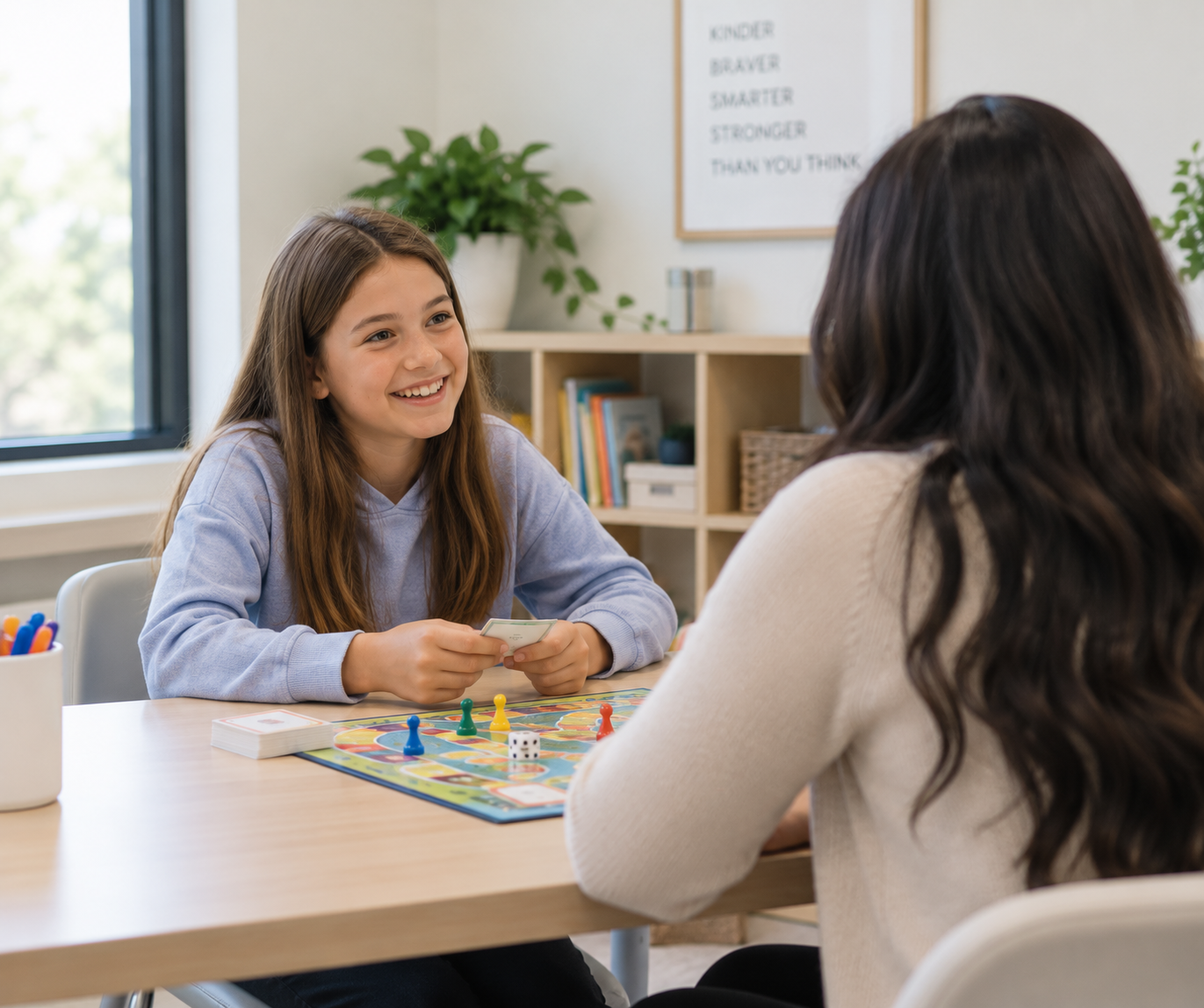
Therapy is purposeful, individualized, and designed for progress. We will continually monitor your child’s response, adjust treatment as needed, and give you strategies to support carryover between sessions.